> For the complete documentation index, see [llms.txt](https://docs.algebra.finance/algebra-integral-documentation/llms.txt). Markdown versions of documentation pages are available by appending `.md` to page URLs; this page is available as [Markdown](https://docs.algebra.finance/algebra-integral-documentation/liquidity-provisioning-tutorials-and-faqs/managing-and-adjusting-positions.md).
# Managing & Adjusting Positions
{% hint style="info" %}
**Note for DEX Teams:**
This section provides a **practical guide to maintaining and optimizing active positions**. It helps users maximize profitability and manage risks—an important UX lever for long-term engagement and user retention.
The illustrated mechanics use **Algebra’s testnet visuals** and are intended as templates for your branded DEX UI.
{% endhint %}
## Where to Find Your Positions
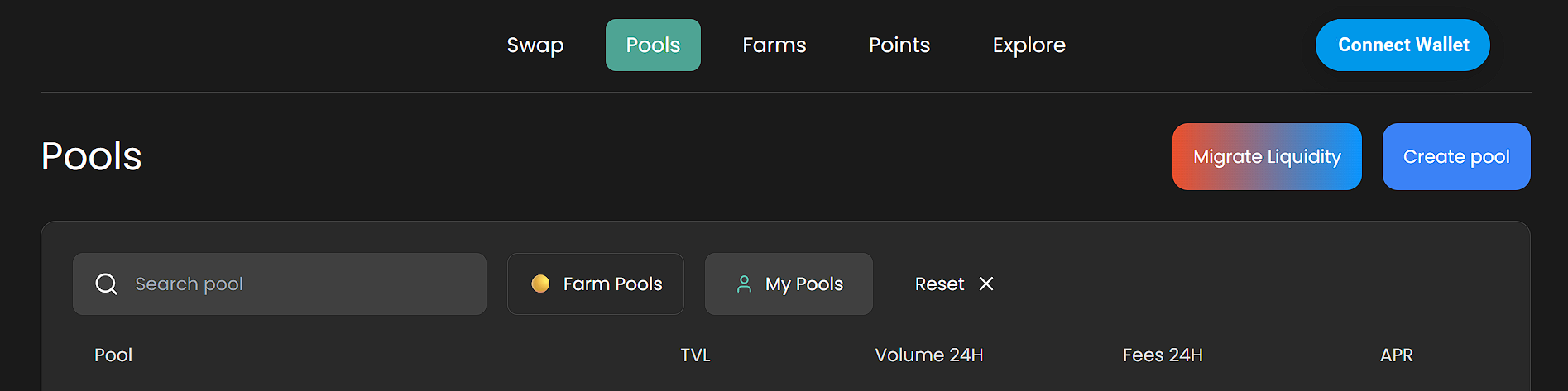
Navigate to the **"My Pools"** tab on the **Pools** page to view all your active and inactive liquidity positions.
### Position Management Options
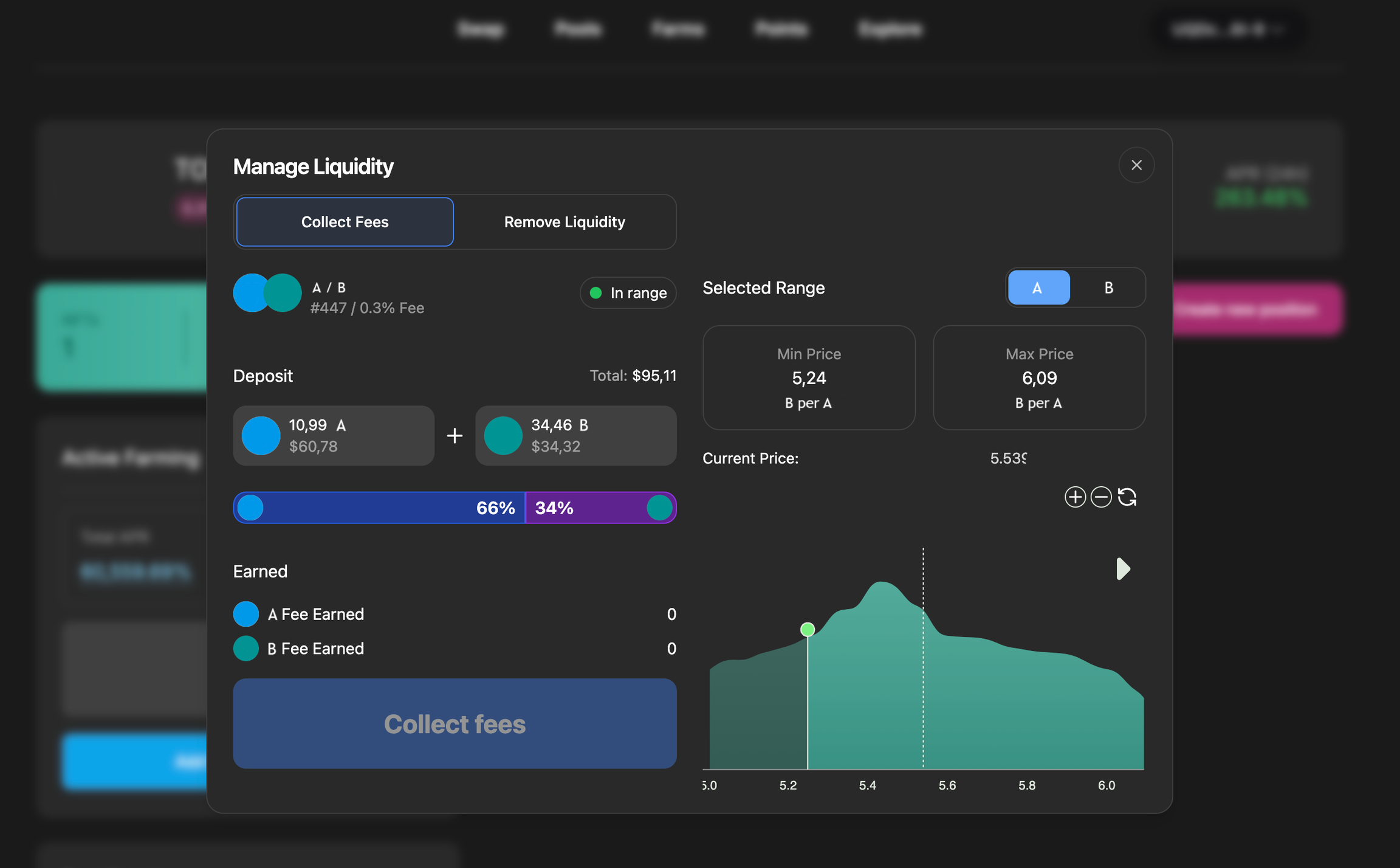
Click on any position to open the **position management panel**, where you’ll see:
* Total Value
* Assets Deposited
* Current Price Range
* Pending Fees / Rewards
* Current Status (Active / Inactive)
From this panel, you can perform the following actions:
**1. Collect Fees**
* Click **"Collect"** to claim all accumulated fees and rewards.
* Confirm the transaction in your wallet.
**2. Withdraw Liquidity**
* Choose **"Remove Liquidity"** to remove all or part of your liquidity.
* You can fully exit the pool or reduce exposure.
* Confirm in your wallet and receive your tokens back.
{% hint style="info" %}
*Note:* You cannot adjust the **price range** of an existing position. If you want to change this parameter, you must first withdraw your position and then create a new one with updated settings.
{% endhint %}
#### Want to learn more about liquidity management strategies?
Check out the following pages to explore different approaches based on your goals and market behavior:
{% content-ref url="/pages/lHI0vSvZlbRrEAO4ZI5k" %}
[Basic Price Range Presets](/algebra-integral-documentation/price-ranges-and-liquidity-strategies/basic-price-range-presets.md)
{% endcontent-ref %}
{% content-ref url="/pages/f5PqB7BFFxtyzU1dOSWY" %}
[Advanced Range Presets](/algebra-integral-documentation/price-ranges-and-liquidity-strategies/advanced-range-presets.md)
{% endcontent-ref %}
{% content-ref url="/pages/SrxhZxgM3ML15LGhoJru" %}
[Matching Your Liquidity Strategy to Market Moves](/algebra-integral-documentation/price-ranges-and-liquidity-strategies/matching-your-liquidity-strategy-to-market-moves.md)
{% endcontent-ref %}
{% content-ref url="/pages/rT23O1j7rSenUbmgLcDX" %}
[Swap & LP Strategies with Price Ranges](/algebra-integral-documentation/price-ranges-and-liquidity-strategies/swap-and-lp-strategies-with-price-ranges.md)
{% endcontent-ref %}
{% content-ref url="/pages/l0WD4geSL0M9Mji78iqI" %}
[Liquidity Scenarios & Risk Profiles](/algebra-integral-documentation/price-ranges-and-liquidity-strategies/liquidity-scenarios-and-risk-profiles.md)
{% endcontent-ref %}